


NCC 2025 Section J explained: Deemed-to-Satisfy, Verification Methods and what changed from 2022
NCC 2025 roughly halves the Section J energy limits, adds an emissions limit, makes on-site solar PV a Deemed-to-Satisfy requirement and makes J1V3 harder to pass. This guide sets out what changed from 2022, how to choose between Deemed-to-Satisfy and a Verification Method, and what to check when the Code changes again.
Why it matters
NCC 2025 moves Section J decisions earlier. The roof layout and finish, the facade, the fuel choice and the main switchboard now carry compliance weight, and the J1V3 margin leaves less room to fix a shortfall after design freeze.
- Developers and builders (cost, programme, risk). On-site solar PV is now a Deemed-to-Satisfy requirement (J9D5). Gas for building services can add PV and reserved switchboard capacity (J9D5(3), J6D10, J8D3 to J8D5). A late substitution of roof sheeting, glazing, fans, chillers or heaters can undo a compliant design.
- Architects and engineers (design and specification). The roof is shared between PV, plant and access, and needs a stated solar reflectance (J4D4). Fans and chillers are assessed under Specifications 46 and 47, and sealing now applies in every climate zone (J5D4 to J5D7).
This guide reflects NCC 2025 Volume One as adopted, with NCC 2022 for comparison.
The big picture: what is NCC 2025 Section J?
Section J is the energy efficiency part of NCC Volume One. Every new commercial building, and many alterations, must meet it. NCC 2025 is the second big commercial step planned under the national Trajectory for Low Energy Buildings. It roughly halves the energy allowance, caps emissions and adds rooftop solar.
There are two ways to comply with Section J:
- Deemed-to-Satisfy (DTS): follow the prescriptive clauses in Parts J4 to J9, covering fabric, sealing, air-conditioning, lighting, heated water, monitoring and solar PV (J2D2). A Class 4 part of a building, such as a caretaker's flat, also follows Part J3.
- Performance Solution: show that the building meets Performance Requirement J1P1, usually through a Verification Method such as J1V3.
The ABCB released NCC 2025 on 1 May 2026.
Who does NCC 2025 Section J apply to, and from when?
NCC 2025 Section J applies to Class 3 and Class 5 to 9 buildings, such as hotels, offices, shops and warehouses. Apartments (Class 2) use Section J of NCC 2022 Amendment 2 instead (in Tasmania, Section J of BCA 2019 Amendment 1; in NSW, BASIX also covers apartment thermal performance). Which edition you use depends on your state's adoption date.
Adoption dates, from the ABCB's state and territory adoption information:
| State or territory | NCC 2025 adoption |
|---|---|
| Victoria | 1 May 2026 |
| ACT | 1 May 2026, with a 12-month transition |
| Western Australia | 1 May 2026, with a 12-month transition |
| New South Wales | 1 May 2027 |
| Queensland | 1 May 2027 |
| Tasmania | 1 May 2027 (temporarily adopted 1 May to 4 June 2026) |
| South Australia | 1 May 2027 (BCA provisions) |
| Northern Territory | Not adopted |
Tasmania applied NCC 2025 temporarily from 1 May to 4 June 2026; NCC 2022 applies again until NCC 2025 is adopted on 1 May 2027. If your Tasmanian project was lodged or approved in that window, check which edition applies. South Australia adopted the Plumbing Code (NCC Volume Three) on 1 May 2026; the BCA, including Section J, follows on 1 May 2027. Source: ABCB, NCC 2025 state and territory adoption information.
For developers and builders: check what sets your edition. Each state uses a different trigger. In NSW, it is the date the construction certificate or complying development certificate application is made (special rules apply to multi-storey buildings with several construction certificates). In WA, a building permit application can use the edition in force when it is made or the one in force 12 months earlier. In the ACT, it depends on when building approval is issued, with an exception for development or works approval applications lodged before 1 November 2026. In Victoria, NCC 2025 applies from 1 May 2026, but the building surveyor can apply the earlier rules if substantial design progress was made before then. Elsewhere, and for any project near a changeover date, confirm the edition with your building surveyor or certifier before design freeze.
For what each state adds on top, see the NCC 2025 by state guide.
What's changed: NCC 2022 vs NCC 2025 at a glance
The biggest Section J changes are the roughly halved J1P1 energy limits with a new greenhouse gas cap, mandatory on-site solar PV under J9D5, tighter roof and HVAC rules, and a harder J1V3. Several warm-climate sealing concessions are gone, and Class 2 has moved out of the NCC 2025 Section J clauses.

| Topic | NCC 2022 | NCC 2025 | Clause |
|---|---|---|---|
| Energy and emissions, Class 6 | 80 kJ/m².hr | 40 kJ/m².hr and 4 g CO₂-e/m².hr | J1P1 |
| Energy and emissions, Class 5, 7b, 8, 9a (non-ward), 9b school | 43 kJ/m².hr | 22 kJ/m².hr and 2.2 g CO₂-e/m².hr | J1P1 |
| Energy and emissions, all other classes | 15 kJ/m².hr | 8 kJ/m².hr and 1 g CO₂-e/m².hr | J1P1 |
| Future renewables and storage | Must allow for future renewables, storage and EV charging | Same requirement, with a new exception where renewables and energy storage are already installed to the maximum practicable extent | J1P4 |
| On-site solar PV | Not required | Required: 100% of roof area less listed exclusions, or the minimum W/m² in Table J9D5a; switchboard space for a battery | J9D5 |
| Roof and ceiling | One set of R-values; roof solar absorptance limit | Higher R-values for Class 3, 9c and 9a ward areas outside climate zone 5; reflectance and emittance options; rules for metal roofs carrying plant | J4D4 |
| Fans and ducts | Fan power limits | Peak fan efficiency under new Specification 46 | J6D5, S46 |
| Chillers | Fixed efficiency tables | Climate-zone efficiency values for each chiller, or a group climate-specific part-load value under new Specification 47 | J6D11, S47 |
| Gas heaters | Lower minimum efficiency for smaller heaters | 90% minimum, at any size, for gas water heaters used in air-conditioning, gas swimming pool heaters and gas heaters for spa pools that share a pool's recirculation system; buildings with gas space heating or gas heated water (including for pool and spa heating) must reserve electrical capacity, switchboard space and supply pathways for future electric equipment | J6D10, J8D3, J8D4, J8D5 |
| Energy monitoring | Meters and monitoring interface | Adds 5-minute logging for major equipment, chillers, heat pumps and zone temperatures where an EMIS is provided | J9D3 |
| EV distribution boards | Included Class 2 carparks | Carparks associated with Class 3, 5, 6, 7b, 8 and 9 buildings (not stand-alone Class 7a carparks) | J9D4 |
| Building sealing triggers | Some items sealed only for conditioned spaces or in climate zones 4 to 8 | Roof lights, doors, windows, exhaust fans and envelope construction sealed regardless of climate zone | J5D4 to J5D7 |
| J1V3 reference building | Must not exceed the reference building; on-site renewables could offset | No more than 97% of the reference building's emissions (a 3% margin); the same-services test now compares services emissions; offset sub-clause removed | J1V3 |
| J1V3 modelling rules | ASHRAE 140 and Specification 34 | Adds Specification 48 (zone-load comparison) | J1V3, S48 |
| Class 2 | Included in Section J | Removed from NCC 2025 Section J clauses; Section J of NCC 2022 Amendment 2 applies instead (BCA 2019 Amendment 1 in Tasmania) | NCC 2022 J1P2; J5D2 |
| Embodied carbon | Not addressed | Still not an NCC requirement; voluntary ABCB handbook | — |
Each row was checked clause by clause against NCC 2022 and NCC 2025 Volume One using Makao's NCC reference tool, and against the ABCB's commercial energy efficiency key changes. NCC text is © ABCB; read the clauses for full wording and exemptions.
Deemed-to-Satisfy: what changed Part by Part?
Under NCC 2025, the DTS route still runs Part by Part from J4 to J9, but nearly every Part is tighter. Fabric picks up roof reflectance rules, HVAC moves to new fan and chiller specifications, pool and spa heating lifts gas efficiency, gas services trigger electrical reservations and J9 adds mandatory solar PV. Plan roof space and plant selections early.
- J4 Building fabric. J4D4 now sets different roof R-values for accommodation-type spaces (Class 3, 9c and 9a ward areas). It also lets the roof's upper surface comply by solar reflectance and thermal emittance, and adds rules for metal roofs with plant on or near them. Walls and glazing (J4D6) use solar admittance tables split by class.
- J5 Building sealing. J5D4 to J5D7 drop the old "conditioned space or climate zones 4 to 8" triggers. Roof lights, doors and openable windows, exhaust fans (unless they must run continuously) and envelope construction now need sealing in every climate zone, so the change bites hardest in warm climates. J5D5 adds new entrance exceptions, and J5D8 keeps evaporative cooler dampers to climate zones 4 to 8.
- J6 Air-conditioning and ventilation. J6D5 sets fan peak efficiency through Specification 46. J6D11 sets chiller efficiency by climate zone, either for each chiller or as a group climate-specific part-load value under Specification 47.
- J7 Artificial lighting and power. Lighting power and controls remain a DTS Part. Check the current clauses and the ABCB lighting calculator before you rely on NCC 2022 layouts.
- J8 Heated water supply and pool plant. Gas heaters for swimming pools, and for spa pools that share a swimming pool's recirculation system, must reach 90% gross thermal efficiency at any size (J8D4 and J8D5). A building with gas heated water for food preparation and sanitary purposes, or for swimming pool or spa pool heating, must reserve electrical capacity, switchboard space, a supply pathway and plant area for a future heat pump (J8D3(3), J8D4(6) and J8D5(6)). In J6, a gas water heater used in air-conditioning must also reach 90% (J6D10(4)), and gas space heating triggers similar electrical reservations (J6D10(5) to (7)). Queensland's variations remove these reservation sub-clauses but keep the 90% values.
- J9 Monitoring and on-site energy. J9D3 adds detailed 5-minute logging where an EMIS is provided. J9D4 keeps EV-ready distribution boards for carparks associated with Class 3, 5, 6, 7b, 8 and 9 buildings. J9D5 requires on-site solar PV and switchboard space for a battery.
For architects and engineers: find the deciding elements first. On most projects, a few elements decide DTS compliance, usually glazing, the roof and the PV area. Identify them at concept stage, before the facade and roof layout are fixed, rather than over-specifying the whole envelope.
Verification Methods: how do J1V1 to J1V4 work in NCC 2025?
NCC 2025 Volume One has four energy Verification Methods: J1V1 (NABERS Energy), J1V2 (Green Star), J1V3 (reference building) and J1V4 (envelope sealing). NCC 2022's fifth method, for Class 2 sole-occupancy units, is gone. J1V3 changed the most: a 3% margin, a revised same-services test and new zone-load checks.
| Verification Method | What it verifies | Main NCC 2025 settings | Change from NCC 2022 |
|---|---|---|---|
| J1V1 NABERS Energy | J1P1 for Class 5, Class 3 and some Class 6 shopping centres | Class 5: 6-star base building Commitment Agreement, with modelled emissions equivalent to at least 6.6 stars (exclusions apply). Class 3 and Class 6 have their own thresholds | Class 5 was 5.5 stars with a 67% emissions test; Class 3 hotels now 4 stars with emissions equivalent to 5.3 stars (was under 70% of 5 stars); Class 6 shopping centres now 6 stars with 6.7-star-equivalent emissions (was 4.5 stars, under 80%); Class 2 common-area route removed |
| J1V2 Green Star | J1P1 for Class 3 and 5 to 9 | Registered for a Green Star Buildings rating; emissions under 90% of the reference building; thermal comfort; Specification 33 | Class 2 common areas and the older Green Star Design & As-Built tool removed |
| J1V3 Reference building | J1P1 for Class 3 and 5 to 9 | Emissions no more than 97% of the reference building with proposed services; with the reference building's services, the proposed building's services emissions no higher than the reference building's (the same-services test); a comfort or zone-load test; Specifications 33, 34 and 48 | Was "not more than" the reference building, with renewable offsets allowed; PMV comfort route now Class 5 only, with temperature-band and zone-load alternatives |
| J1V4 Envelope sealing | Building sealing (J1P1(a) and J1P2) | Air permeability limits at 50 Pa for Class 4 parts, Class 5, 6, 8, 9a and 9b (climate zones 1, 7 and 8) and Class 3, 9c and 9a ward areas (listed climate zones) | Class 2 removed |
| NCC 2022 Class 2 method (removed) | — | Not in NCC 2025 Volume One | NCC 2022's Class 2 unit reference-building method removed |
Warning: J1V3 is the bigger lift. Under NCC 2022, a design could match the reference building and pass both runs. Under NCC 2025, modelled with its proposed services, it must come in at no more than 97% of the reference building's emissions (a 3% margin). Modelled with the reference building's services, its services emissions can be no higher than the reference building's. Expect less room for late fabric trade-offs.
DTS or Verification Method: which path should you take?
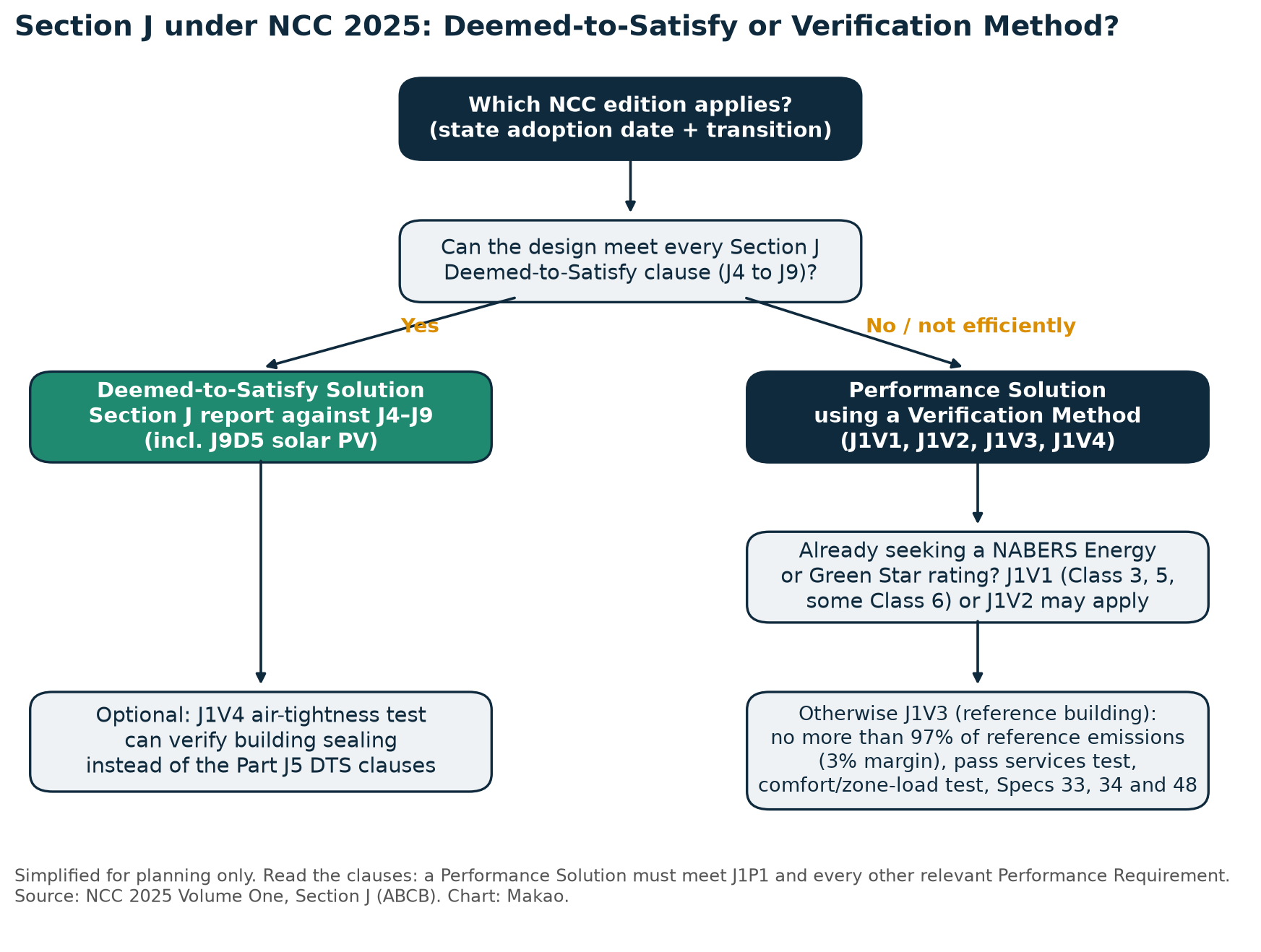
Use DTS when the design can meet every Part J4 to J9 clause without awkward compromises. Use a Verification Method when one element, often glazing, breaks DTS or a better outcome needs flexibility. Under NCC 2025, decide at concept stage, because J1V3's margin leaves little room for late fixes.
Rules of thumb (planning only, not a compliance determination):
- Glass-heavy facade or unusual form? Test J1V3 early. If it won't pass at concept stage, it rarely passes later.
- Simple box with modest glazing? DTS is usually quicker and cheaper.
- Already seeking a rating? J1V1 or J1V2 may suit, but check the class, scope and thresholds in the clause.
- Air-tightness testing planned? J1V4 can verify sealing in place of the Part J5 DTS clauses.
What changes on the drawings and specifications?
Most NCC 2025 changes land in documents that NCC 2022 Section J barely touched: the roof plan, the electrical single-line diagram and switchboard schedule, the exhaust fan schedule and the BMS points list. Use this table to assign each item to a document and an owner.
| Document | What to show under NCC 2025 | Clause | Usually owned by |
|---|---|---|---|
| Roof plan | The PV zone, with each excluded area marked and its reason: plant and services, roof lights, access and height-safety paths, roof gardens, terraces, awnings, car parks, areas above heat-rejection exhaust, pitches over 45°, areas shaded for more than 25% of annual daylight hours, and areas where panel size or mounting makes PV impractical | J9D5(2) | Architect, electrical engineer |
| Roof specification | The upper surface's solar reflectance and thermal emittance (or SRI, or solar absorptance) in climate zones 1 to 7. Tighter values apply in climate zones 1, 2, 3, 5 and 6 to a metal roof with outside air intakes, unitary air-conditioners or air-cooled chillers on it or less than 2 m above it. Roof under PV panels or a rooftop garden is exempt | J4D4(2) to (4) | Architect |
| Roof and ceiling sections | Total R-value, with the higher values for Class 3, Class 9c and Class 9a ward areas (the values are the same in climate zone 5) | J4D4(1) | Architect |
| Main switchboard schedule and single-line diagram | At least 2 empty three-phase circuit breaker slots and 4 DIN rail spaces, labelled for a battery system (not needed where batteries are installed), plus any labelled reservations triggered by gas space heating or gas heated water, including pool and spa heating | J9D5(1), J6D10(5), J8D3(3), J8D4(6), J8D5(6) | Electrical engineer |
| Mechanical specification | Fan peak efficiency (Specification 46); chiller efficiency by climate zone, per chiller or as a group part-load value (Specification 47); 90% gross thermal efficiency for any gas water heater used in air-conditioning | J6D5, J6D11, J6D10(4) | Mechanical engineer |
| Hydraulic specification | 90% gross thermal efficiency for gas swimming pool heaters and for gas heaters on spa pools that share a pool's recirculation system; future heat pump reservations where sanitary, pool or spa water is gas heated | J8D3, J8D4, J8D5 | Hydraulic engineer |
| Door, window and roof light schedules and details | Seals on doors, openable windows and roof lights in every climate zone; entrance airlocks or self-closing doors, with the J5D5 exceptions noted | J5D4, J5D5 | Architect |
| Exhaust fan schedule | A self-closing damper or similar on each exhaust fan, unless the fan must run continuously | J5D6 | Mechanical engineer |
| BMS or EMIS points list | Where an EMIS is provided: 5-minute logging of major equipment, chillers and heat pumps, and all air-conditioning zone temperatures | J9D3 | Mechanical and electrical engineers |
| Carpark electrical layout | EV-ready distribution boards for carparks associated with Class 3, 5, 6, 7b, 8 and 9 buildings | J9D4 | Electrical engineer |
| Glazing schedule | Inputs for the J4D6 solar admittance and U-value check, run in the ABCB glazing calculator | J4D6 | Architect |
Which decisions are hard to reverse?
Five decisions set most of the Section J outcome, and each becomes expensive to change once the design is coordinated. Make them deliberately at concept stage and record who made them.
- The compliance path and the edition. Moving between DTS and J1V3 late means a new assessment. Under NCC 2025, a design that only matches the reference building no longer passes J1V3: with its proposed services, it must come in at no more than 97% of the reference building's emissions. For developers, this is a programme risk as much as a technical one.
- The fuel choice. Gas for building services can add PV capacity (J9D5(3) and Table J9D5b, depending on building class and climate zone), sets 90% efficiency for gas water heaters in air-conditioning and for gas pool and shared-system spa heaters, and triggers electrical reservations for future electric equipment (J6D10(5) to (7), J8D3(3), J8D4(6) and J8D5(6)). Settle all-electric or gas before the roof and the switchboard are laid out.
- The roof allocation. J9D5(2) gives two routes: PV over the roof area left after the listed exclusions, or a minimum peak output per square metre of conditioned space from Table J9D5a. Plant, terraces, roof gardens and access paths all shrink the first route, and the building's roof-to-floor-area ratio decides which route is easier. Check both before plant, amenity and PV are allocated.
- The facade and glazing. Glazing is the element that most often breaks DTS, and J4D6 splits its tables by class. Changing glazing performance or area after the facade is coordinated affects compliance, cost and daylight together.
- The main switchboard. The battery slots, DIN rail spaces and any gas-triggered reservations belong in the main switchboard. They are simple to allow for in the design and harder to add once the board is built.
Where do projects get caught at building approval?
These are common reasons a Section J submission goes back for more information. Each one is cheaper to catch in design review than at building approval.
- The wrong edition. Documents prepared under one edition while the application or approval date falls under another. Check your state's trigger (see the callout above) for any project near a changeover.
- Missed classifications. Class 3, Class 9a ward and Class 9c parts have higher roof R-values in most climate zones (J4D4(1)), and J1V4 applies its sealing limit to them in more climate zones. Mixed-use buildings often miss them.
- PV exclusions without evidence. A roof plan that shows an array but does not measure the excluded areas, or claims a shading exclusion without a basis for the 25% of annual daylight hours.
- Roof finish changed in value management. A darker roof sheet, or a metal roof under new plant, can fail J4D4(2) or (3) after the Section J assessment was done.
- Sealing that was not needed before. In warm climate zones, roof lights, doors, openable windows and exhaust fans that NCC 2022 did not require to be sealed now need seals or dampers (J5D4 to J5D7).
- A J1V3 report that does not match the documents. The model's fabric and services must match what is documented, and the report must show the 97% test, the same-services test and the comfort or zone-load test.
- Gas added late. Gas added for building services after the roof and switchboard are coordinated can trigger extra PV under J9D5(3), depending on class and climate zone, and electrical reservations under J6D10, J8D3, J8D4 or J8D5.
- Grid connection left late. The NCC's explanatory information for J9D5 notes that the network operator's connection rules still apply, and may call for a dynamic connection, demand response or on-site storage. Ask the network operator early.
What should you ask your engineers and building surveyor?
Use these questions at concept and design development reviews. They are written so that a project lead can ask them without being a Section J specialist.
Ask your mechanical and electrical engineers:
- Do the fan selections meet the Specification 46 peak efficiency at their duty points?
- Are the chillers assessed per chiller or as a group under Specification 47, and for which climate zone?
- Will any building service use gas? If so, what extra PV does Table J9D5b add for this class and climate zone, and what electrical reservations do J6D10, J8D3, J8D4 and J8D5 require?
- Is an EMIS provided? If so, does the points list include the 5-minute logging that J9D3(5) requires?
- Where are the battery slots and DIN rail spaces on the main switchboard schedule?
- Has the network operator been asked about connection conditions for the PV system?
Ask your building surveyor or certifier:
- Which NCC edition applies to this project, and what date triggers it?
- How do you want the PV exclusions and any shading exclusion evidenced?
- If we use J1V3, what do you expect the report to show for each test and for Specifications 33, 34 and 48?
- Which state variations apply to Section J here?
Developers and builders, ask your design team:
- Which elements decide compliance on this project, and what would a late change to each one cost in re-assessment?
- Which value management items are compliance-critical: roof sheeting, glazing, fans, chillers, heaters, seals or dampers?
What has the ABCB published to help with NCC 2025 Section J?
The ABCB has published a Commercial Energy Efficiency Handbook, worked examples for retail, community and office buildings, a fan and duct guide, a chiller selection example, a solar PV example and updated calculators. They are free, and they show how the ABCB applies the new clauses. The PV and chiller examples are worth circulating to the services engineers.
All links were checked on 2 November 2026. The full library is on the ABCB's energy efficiency resources page.
Handbook
Case studies and worked examples
- Energy efficiency compliance for a retail building: case study
- Energy efficiency compliance for a retail building
- Energy efficiency compliance for a community centre: case study 1
- Fan and duct system
- Chiller plant selection for an office building (Class 5, climate zone 5)
- Building envelope compliance for an office building (Class 5, climate zone 5)
- On-site solar PV compliance for an office building (Class 5, climate zone 6)
Calculators
Reference
What they're saying
Reaction to NCC 2025 has been broadly supportive of the commercial energy changes. The Green Building Council welcomed the carpark energy efficiency and solar readiness provisions, the property sector welcomed the certainty, and builders welcomed the residential pause. One modelling software publisher, Better Building, says J1V3 is "the bigger lift" in updating its tools.
- Green Building Council of Australia. Chief Executive Davina Rooney welcomed the new carpark energy efficiency and solar readiness provisions and said: "The National Construction Code is one of Australia's most powerful tools for improving building performance and reducing emissions across our homes and workplaces" (GBCA media release, 22 October 2025).
- Property Council of Australia. Chief Executive Mike Zorbas said the ministers' endorsement "strikes a balance" and stressed national consistency (Property Council, 23 October 2025).
- Master Builders Australia. CEO Denita Wawn welcomed the pause on further residential changes. She argued the Code had moved from minimum standards towards best-practice benchmarks (Master Builders Australia, 23 October 2025).
- Housing Industry Association. HIA described NCC 2025 as having a predominantly commercial building focus (HIA, 1 May 2026).
- Better Building. The modelling and compliance publisher calls J1V3 "the bigger lift" (Better Building: NCC 2025 Section J release date). In its reading of the clauses:
- the reference building's solar admittance for Class 5 to 9b has dropped;
- the PMV comfort route is now limited to Class 5;
- how PV is treated in the reference building is open to interpretation, so it suggests checking with the ABCB.
(Better Building: J1V3 verification using a reference building). These are Better Building's interpretations, not ABCB guidance.
Zoom out: where is the Trajectory for Low Energy Buildings heading?
The national Trajectory for Low Energy Buildings sets the direction for NCC energy rules. Energy ministers first agreed it in 2019 and updated it in 2025, with an aim of a net zero building sector by 2050. Expect future Section J changes to focus on refinement, electrification and existing buildings.

- Where it started. The COAG Energy Council's Trajectory for Low Energy Buildings set the goal of "zero energy (and carbon) ready" buildings. It planned substantial commercial updates in NCC 2022 and NCC 2025 (2019 Trajectory, pp. 4–7), with an estimated net benefit of $25 billion to 2050 for the commercial changes (p. 2).
- Who runs it now. COAG was replaced by National Cabinet in 2020, and energy ministers now meet as the Energy and Climate Change Ministerial Council (ECMC), established in 2022. The ECMC agreed the 2025 Update on 15 August 2025 (p. 4). It then agreed an Implementation Plan 2026–27 on 16 December 2025.
- Why NCC 2025 looks the way it does. The Decision Regulation Impact Statement modelled three stringency levels:
- Level 1: net benefit of $6.8 billion;
- Level 2 (with PV): $10.0 billion;
- Level 3 ("zero carbon ready", the preferred option): $9.4 billion.
Proposed additional EV charging requirements (beyond the existing J9D4 EV-ready provisions) showed a net cost of about $1.74 billion and were not included.
Note: Expectations, not commitments.
- The 2025 Update expects NCC 2025 to cut operational emissions from new commercial buildings by more than 50%. The document itself says this is "to be confirmed post BMM decision" (p. 11).
- Further NCC energy work is expected to be mostly refinement and simplification, plus all-electric design where feasible, data centres and cold stores, monitoring and controls, future climate and heatwaves (Action 14, pp. 21–22).
- Embodied carbon stays voluntary for now. Building ministers put it in an ABCB handbook rather than the Code (BMM communiqué, 22 October 2025).
- Ministers also agreed work on the cadence of future NCC updates, so the timing of the next edition is not fixed.
Printable checklist by role
Use this checklist at concept design and again before you apply for building approval. Items are grouped by who usually owns them, so each lead can take their section into the next design meeting. Print it, tick it off and keep it on the project file.
Project lead, developer or owner
- ☐ Confirm which NCC edition applies (state adoption date, any transition period, and the application or approval date your state uses).
- ☐ Confirm the building classification(s), including any Class 3, 9a ward or 9c areas with different roof R-values and J1V4 sealing coverage.
- ☐ Confirm the climate zone.
- ☐ Choose a path: DTS, or a Verification Method (J1V1, J1V2, J1V3), at concept stage.
- ☐ Decide all-electric or gas for building services before the roof and switchboard are laid out (J9D5(3), J6D10, J8D3, J8D4, J8D5).
- ☐ Check state variations with your building surveyor or certifier.
Architect
- ☐ Reserve roof area for solar PV under J9D5, mark the exclusions on the roof plan, and check the Table J9D5a minimum.
- ☐ Specify the roof's solar reflectance and thermal emittance, and check any metal roof carrying plant (J4D4).
- ☐ Check glazing against the J4D6 solar admittance and U-value tables, using the ABCB glazing calculator.
- ☐ Detail seals on every roof light, door, openable window and envelope junction (J5D4 to J5D7), or plan a J1V4 air-tightness test.
- ☐ If J1V3: have a concept model run against the 3% margin (no more than 97% of the reference building's emissions) and the same-services test before the facade is fixed.
Services engineers
- ☐ Give the mechanical engineer the Specification 46 (fans) targets and the J6D11 chiller values (per chiller, or Specification 47 for a chiller group).
- ☐ Confirm any gas water heater used in air-conditioning, and any gas swimming pool or shared-system spa pool heater, reaches 90% gross thermal efficiency (J6D10(4), J8D4 and J8D5), or electrify.
- ☐ Show the battery slots and DIN rail spaces, and any gas-triggered reservations, on the main switchboard schedule (J9D5(1), J6D10(5), J8D3(3), J8D4(6), J8D5(6)).
- ☐ Confirm dampers on exhaust fans that do not run continuously (J5D6).
- ☐ Confirm the energy monitoring scope and any 5-minute EMIS logging (J9D3).
- ☐ Confirm EV-ready distribution boards for carparks (J9D4).
Builder
- ☐ Check any substitution of roof sheeting, glazing, fans, chillers or heaters against the Section J assessment before it is accepted.
- ☐ Check seals, dampers and entrance doors are installed as documented, and book any J1V4 air-tightness test early.
What to check when the NCC changes again
When a new NCC edition is released, check six things before reusing anything from this guide: the J1P1 limits, the Verification Method list and margins, the Specifications J1V3 cites, the J9 solar and monitoring clauses, your state's adoption date and any new ABCB handbooks or case studies.
- J1P1 limits: have the energy or emissions caps changed?
- Verification Methods: have any been added or removed (as NCC 2022's Class 2 method was in NCC 2025), or has the J1V3 margin moved?
- Specifications: have Specifications 33, 34, 46, 47 or 48 been revised or renumbered?
- J9: has the J9D5 solar PV clause or the J9D4 EV clause changed?
- Adoption: what are each state's adoption and transition dates?
- ABCB resources: are there new handbooks, case studies or calculator versions?
We will update this page when that happens. Check the "Last updated" line at the top.
Glossary
Plain-English definitions of the terms used in this guide. Where a term is defined in the NCC, the NCC definition governs. Use these as a quick reference when you read a Section J report, a J1V3 modelling report or a building surveyor's or certifier's request for information on a commercial project.
- ABCB: Australian Building Codes Board, which publishes the NCC.
- BMM: Building Ministers' Meeting, the ministers who agree changes to the NCC.
- Class: the NCC building classification. For example, Class 3 covers hotels and boarding houses, Class 5 offices, Class 6 shops and Class 9b schools and assembly buildings.
- Climate zone: one of the NCC's eight climate zones, which change many Section J values.
- Deemed-to-Satisfy (DTS) Provisions: the prescriptive clauses (Parts J4 to J9) that are deemed to meet the Performance Requirements.
- DTS Solution: a way of complying by following the DTS Provisions.
- ECMC: Energy and Climate Change Ministerial Council, which oversees the Trajectory for Low Energy Buildings.
- EMIS: Environmental Management Information System, a central system that collects energy and plant data.
- J1P1: the Section J Performance Requirement for operational energy use and greenhouse gas emissions.
- Performance Requirement: the outcome the NCC requires, such as J1P1.
- Performance Solution: a way of meeting the Performance Requirements other than by a DTS Solution.
- PMV: Predicted Mean Vote, a thermal comfort index used in J1V1 to J1V3.
- Reference building: a notional DTS-compliant version of the proposed building, used as the benchmark in J1V2 and J1V3.
- Solar admittance: a measure of how much solar heat a wall-glazing system lets in (J4D6).
- Specification: a detailed NCC method, such as Specification 48 for zone-load comparison.
- Verification Method (VM): a test, inspection or calculation that shows a Performance Solution meets the Performance Requirements, such as J1V3.
FAQ
When does NCC 2025 Section J apply?
It depends on your state. Victoria, the ACT and WA adopted NCC 2025 from 1 May 2026, with transitions in the ACT and WA. NSW, Queensland and Tasmania follow on 1 May 2027 (Tasmania applied it temporarily from 1 May to 4 June 2026), and South Australia adopts the BCA provisions then too. The Northern Territory has not adopted NCC 2025.
Does NCC 2025 Section J apply to apartments?
No. The NCC 2025 Section J changes cover Class 3 and Class 5 to 9 buildings. For apartments (Class 2), NCC 2025 applies Section J of NCC 2022 Amendment 2 instead (BCA 2019 Amendment 1 in Tasmania), and building ministers paused further residential changes until mid-2029.
Is solar PV mandatory under NCC 2025?
Yes, for buildings using the Deemed-to-Satisfy Provisions. J9D5 requires an on-site solar PV system covering the roof area less listed exclusions, or meeting a minimum output per square metre from Table J9D5a. It also requires switchboard space for a future battery.
What does J9D5 require at the main switchboard?
The main electrical switchboard must contain at least 2 empty three-phase circuit breaker slots and 4 DIN rail spaces, labelled for a battery system. This does not apply to a building with battery systems installed.
What are the NCC 2025 Section J Verification Methods?
NCC 2025 Volume One has four: J1V1 (NABERS Energy), J1V2 (Green Star), J1V3 (verification using a reference building) and J1V4 (verification of building envelope sealing). NCC 2022's fifth method, for Class 2 sole-occupancy units, is not in NCC 2025.
Is J1V3 harder under NCC 2025?
Yes. The proposed building must emit no more than 97% of the reference building's emissions with its proposed services. Modelled with the reference building's services, its services must not emit more than the reference building's, and it must pass a comfort or zone-load test. Specification 48 adds zone-load comparison rules. Test J1V3 at concept stage.
Is embodied carbon part of NCC 2025 Section J?
No. Embodied carbon is not an NCC 2025 requirement. The ABCB has published voluntary embodied carbon provisions in a separate handbook, which states and territories may choose to adopt.
Cover image: Engraving by George Measom, from Berlyn & Fowler, The Crystal Palace (1851). Public domain, via Wikimedia Commons.
Questions or corrections: contact Makao.


